 A campus tourThe campus touring season is in full swing. By the time parents are preparing, er, I mean paying, for High School graduation and one final prom, it’s likely that they’ve visited quite a few college campuses, both near and far from home.This story is not about motorbike travel. It’s about another kind of specialized mini-vacation of sorts — the college campus recon mission. In this case, it’s the University of Oregon in Eugene.
 Apologies for straying from the usual subject matter for Dirt Riders’ Digest, but what the heck, the pictures are pretty — and there are the bicycles. Yep, those ducks appear to love their bikes. As one current student explained, “having a bike is, well I guess it’s pretty essential.” There are more bicycles parked on campus than I’ve ever seen in one place at one time. So, that’s the bit about two-wheeled transport, just to make this almost about motorbikes. And while in Eugene, there is a plan to visit the local BMW motorcycle dealer, so there is that.
 But I digress. The UO campus is an interesting mix of old and new, but mostly new. The park-like atmosphere is heavily treed and very green. On an early spring day the smell of freshly mown grass is heady. It’s all very far from New Mexico in so many ways.
The tour’s focus is on the two most essential questions, where to sleep and what to eat. For parents whose college experience in now far in the past, it’s a jolt to remember just how small typical dorm rooms are. They seemed so much bigger back then, am I wrong? There does seem to be much more choice in dining, as well, so much more than beer and burgers — in fact there don’t seem to be any beer or burgers, oddly enough.
Anyway, the university’s student recreation facilities, student union, business complex, Knight library, and science complex are all very impressive. It really is a big, beautiful, and on a sunny day, busy campus.
For those of us who were in college when the movie Animal House was released, there is a final highlight. Johnson Hall, the UO administration building, doubled as the administration building for fabled Faber College in the movie, which was filmed largely at the University of Oregon. Ah, the memories of Bluto, D-Day and Flounder giving that White Stallion a heart attack in Dean Wermer’s office … but maybe that’s just me.
 So it looks highly likely that there will soon be an Oregon Duck in the family. Call me obsessed, but I’m already trying to figure out routes to central Oregon that’ll make an interesting motorbike trip.
Origins of New Mexico’s popular image
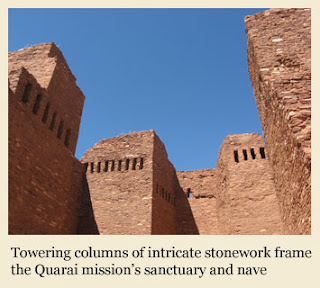 Little is better than a break in the weather that invites a day-long ride to a place that’s steeped in history, both real and contrived, across roads that are far from the Interstate, abundantly curvy, and visually astounding.
New Mexico is a strange and wonderful place, truly the Land of Enchantment. But not for the reasons most people think. People see silver and turquoise jewelry, adobe (or what passes for adobe) architecture, a strong ancient native culture crossed with a stronger Spanish Colonial heritage, an impossibly big, blue sky; a sparse, tan, almost empty landscape; and it all seems based on a culture that’s, well, primitive.
There are a few places from New Mexico’s past that still lend insight into the origins of the New Mexico of today. Some are going concerns, such as the Taos Pueblo. Others are long abandoned, like the Gila cliff dwellings, the ruins at Chaco Canyon, and the amazing Salinas Missions. 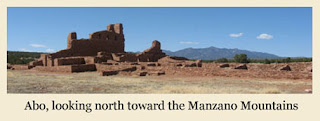 Now there’s old … and there’s old. In Europe, structures dating to the 1580s aren’t all that old, really. But in the United States, established in 1776, a large building from 1580 would generally be considered very old. Well, in 1581 the pueblo of Quarai was a thriving community of more
 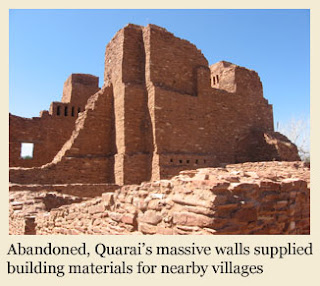 than 400 people, just southeast of what is now Albuquerque. It’s not known exactly how long Quarai had been there before the Spaniards visited for the first time in that year, but it had clearly been there a long time.
Visiting there now is not only fascinating, but also a really fun motorbike ride. It’s about a 250 mile ride round trip from Santa Fe. Starting out south on State Road 14, through the semi-famous artists’ hamlet of Madrid. At Interstate 40 near Tijeras the road essentially becomes State Road 337 and gets twisty. The blacktop snakes through mountainous terrain emptying into a plain and turning to State Road 55, revealing a collection of tiny settlements called Escobosa, Chilili, Tajique, and Torreon along the way, all with storied colonial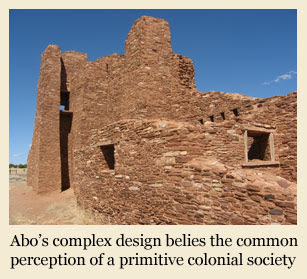 histories of their own. The Quarai ruin is nearby the tiny village of Punta de Agua.The Salinas Missions, Spain’s colonial, religious strongholds, though in ruins and long ago abandoned, have a very strong influence on what people are thinking when they think of New Mexico today. The Missions, Gran Quivera, Quarai, and Abo, along with their more northern cousin, the Mission ruin at Pecos, formed the basis for what we now know as “Pueblo Revival Architecture.” The Mission ruins are part of the National Park Service. The facilities are
  excellent, the ruins well preserved, and the Rangers expert. There is no camping, but there are excellent little museums, picnic tables, and clean restrooms.
Believe it or not, the predominant architectural style of Santa Fe in the 1910s was, like most of America, quite brick-a-brack and brightly-colored Victorian. There are stacks of books on how Victorian Santa Fe became “Pueblo Revival” Santa Fe, but if you want to actually see some of the influencing style, go to Quarai.
The architectural complexity is stunning. Neither the native peoples nor the Spanish priests were building primitive structures. And the people were getting along. The evidence of native “Kivas,” places of native religious ceremony built inside the Mission grounds, lead most historians to believe that a get-along-go-along culture existed for many years.Of course the whole thing had to blow up. The Spanish delusion of “El Dorado” riches did not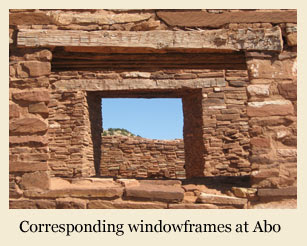 materialize. The home government of Spain demanded tribute and so the priests and government officials clashed over the priorities of tribute to State versus tribute to God.
It was so bad that it all came apart for the southern Salinas Missions about 10 years before the more famous, exceedingly violent, Pueblo Revolt of 1680 in the north. Whether you are riding for the day or on a longer trip, if your route takes you through central New Mexico, a stop at one of the Salinas Missions is a valuable way to touch a bit of the old that has had a real influence on the new.
A not-too-big windscreen you can see throughThe stock windscreen on the current models of the BMW R1200GS is a marvel of molding. The squared-off design is a futuristic angular beauty that, on the road, is more about looks than function. Sure, it keeps the wind from blasting you directly in the chops, but doesn’t really redirect the rain or substantially buffer buffeting from 18-wheeler bow wave or windshear on really windy days. Plus, after about a year on the road, the tiny scratches from repeated washings in the West’s exceptionally dusty environment begins to turn the stock shield slightly smoky and soft-focus.A really big windscreen is great in the rain. Full-on touring types always rave about their electrically adjustable see-through barn doors that they raise up with the flick of a switch and hide behind when the weather’s nasty.
Smaller windscreens look good, though, and weirdly enough, a big part of motorbiking is all about how you look.
It’s not easy to find a replacement windscreen for the GS that’s big but not too big; cheap but not cheap looking, aerodynamic and scratch-resistant, tough without being clunky, optically pure with minimal color, and free of lightwave interference lines at the plastic bend points. What’s wrong with wanting it all?
There are tons of aftermarket windscreens out there. The biggies include perennials Aeroflow, Cee Bailey’s, and Parabellum. Newer to the scene are Givi and ZTechik. All offer aftermarket windscreens specifically for the GS. Larger screens require additional hardware to keep vibration at a minimum.
 The Z2242 from ZTechnik meets nearly all the stated replacement requirements, even though it would be better if it was just a bit bigger. It mounts easily in about 30 minutes using the existing windscreen hardware. It’s as clear as a bell. It’s made from 4.5 mm hardcoated polycarbonate, so it’s tough and scratch resistant. At about $150 it’s just about the least expensive windscreen out there. Its shape is rounder than the stock windscreen, and a modest 2 inches taller and 4 inches wider. But at 80 mph it’s an obvious improvement, blocking more wind with less buffeting.
It’s odd that you can’t order a ZTechnik product directly from ZTechnik, but must go through an authorized dealer. It’s not a big deal, though, as the Z2242 arrived from A&S BMW in about 10 days.
 Just a couple of installation tips: Watch out for the vanishingly small nuts, bolts, and washers that easily drop out and disappear into the black hole of the garage floor. To reduce the stress on the plastic and to dampen potential vibration, add a couple of small rubber faucet washers to the front mounting points.
A bigger windscreen may eventually be part of the motorbike’s future. It’ll be interesting to see how the ultra-clear poly holds up over time and many miles and how well the design sheds the rain away. But for now, the ZTechnik fits and feels like an excellent alternative to the Star Trekian sheet of acrylic that comes standard on the GS.
An Unimaginable JourneyPeople’s fascination with a post-apocalyptic world has produced a wide variety of books and movies based on the subject. The classic Australian film The Road Warrior starring an impossibly young Mel Gibson remains the Gold Standard of world-gone-mad, car-crashing survival-at-all-costs tales. Too bad the prequel and sequel, Max and Thunderdome failed to be equal.  Actor/Director Kevin Costner has also made two “what if the world blew up” movies, Waterworld and The Postman.
Now that the film adaptation of Cormac McCarthy’s No Country for Old Men has won the best film Oscar it is certainly only a matter of time before a movie of The Road (2006, Vintage Books) McCarthy’s Pulitzer Prize winning story of survival on a charred and hostile Earth, goes into production.McCarthy’s vision of America the Destroyed is exceptionally bleak. At least Waterworld’s Costner got a cool catamaran, a tan, and the sultry sex appeal of Jean Tripplehorn. Even Gibson got a sawed-off shotgun, a bitchin’ booby-trapped hot-rod, and a dingo. All the main characters in The Road have is a blue plastic tarp, debilitating lung disease, a broken down shopping cart, and a well-deserved, hyperactive paranoia. Unexpectedly though, The Road is strangely uplifting.The realism is breathtaking. McCarthy’s economy of language is masterful. The result is a story of journey, hunger, survival, death, fear, and a father’s devotion that tattoos images on the brain. It’s a day-to-day description of satiating the simplest, minimal needs under the most terrible circumstances, yet clinging to hope in the face of hopelessness. It’s a frightening, suspenseful book that’s impossible to put down. Like the main characters in The Road you must keep going even though the temptation to give up is there on just about every page.Like a lot of life’s journeys, a big part of you really doesn't want to go, but you do—because, ultimately, you are better for it.Obviously, not all great books translate easily into movies. But, if this one does, Mel’s Mad Max could be in for some serious cinematic competition.


 A campus tour
 But I digress. The UO campus is an interesting mix of old and new, but mostly new. The park-like atmosphere is heavily treed and very green. On an early spring day the smell of freshly mown grass is heady. It’s all very far from New Mexico in so many ways.
  beer or burgers, oddly enough.


